
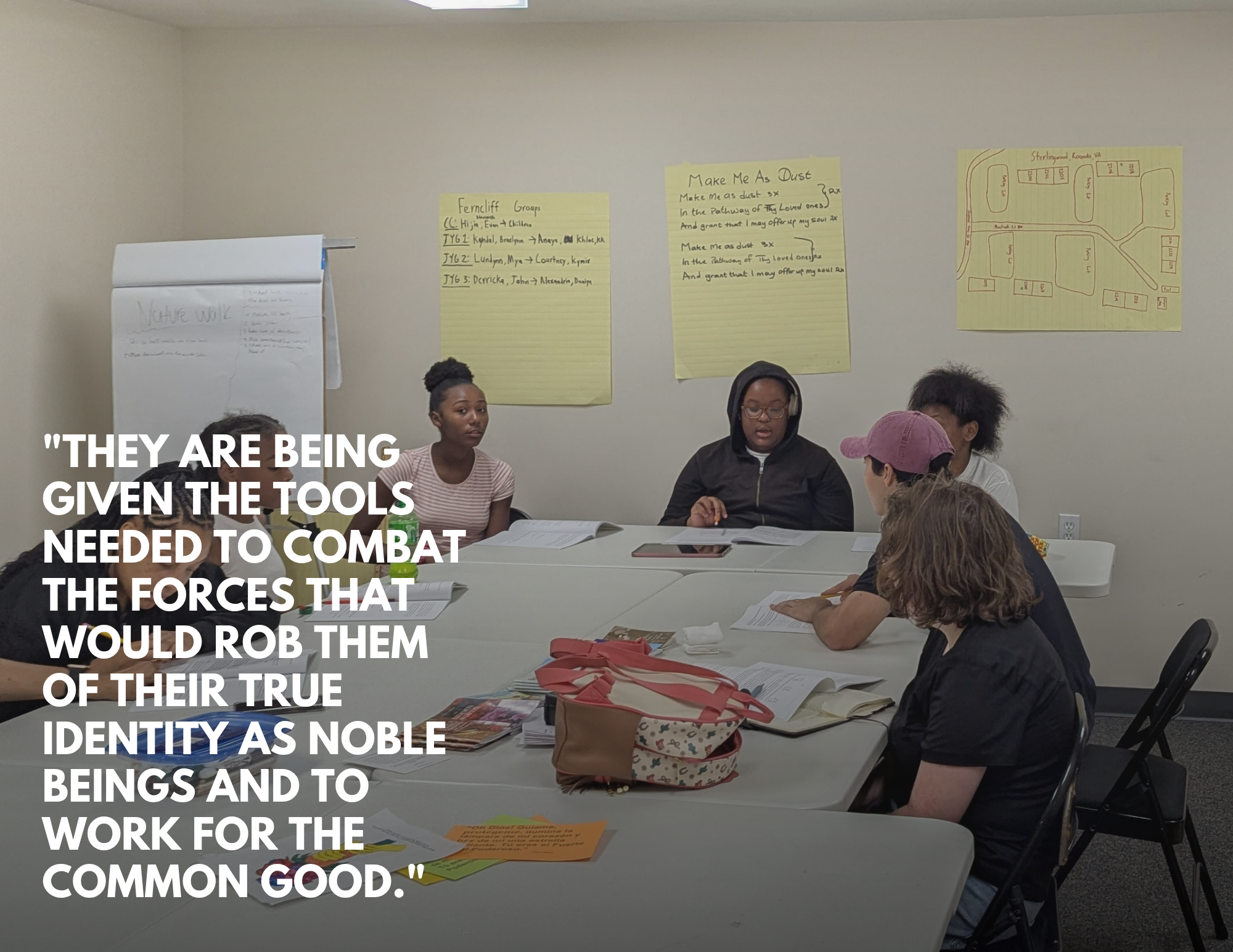
The Junior Youth Spiritual Empowerment Program provides tools to empower teens ages 12 to 15 years old to guard themselves from the negative influences around them, build their capacity to make moral choices and to serve the betterment of their community.
Older youth and young adults are trained to mentor junior youth. They help them form a junior youth group with their peers. The group meets weekly to study texts based on moral and spiritual concepts and to talk about how to navigate a complex world. Together the youth learn to identify and resist negative influences in their lives, and to promote social progress. Together they plan service projects, play games and sports, and make art, all while forming deep friendships with their peers.
Participants who advance through the full curriculum, in both weekly groups and camps, report improved mental health and social outcomes — better attitudes toward their education, stronger relationships with family, adults, and peers.
-
The junior youth curriculum is structured around a series of 15 texts, studied over three years. Each texts follows the stories of middle schoolers around the world grappling with real questions — how to choose a path in life, how to hold onto hope facing the world's problems, how to use math and science for fairness and justice, why to give back to a community when you have needs of your own.
Groups reflect on these stories together while building language, math, and science skills, and take part in artistic, cultural, athletic, and craft activities alongside the curriculum. With their mentors' support, junior youth plan and carry out community service projects.
All of the texts build language skills and the power of expression; some also address mathematical concepts and social issues, and others prepare young people to investigate physical, social, and spiritual reality in a scientific manner.
Twelve of the fifteen texts draw their moral concepts from a broader spiritual and ethical tradition, including the Bahá'í teachings, without being religious in nature or tied to any single faith directly — many schools and community organizations use them for this reason. The remaining three explore the Bahá'í teachings and writings more directly.
-
Junior youth camps run throughout the year, offering group bonding with junior youth from across the area, guided discussion of the curriculum, arts and STEM activities, service projects, and occasional field trips. Camps generally run on a pay-as-you-can model, with full and partial scholarships available to those who need them. Offerings typically include a summer day camp, overnight camps over school breaks, and shorter monthly camps.
-
During the school year, junior youth meet in weekly groups — after-school clubs at a school or community center, or neighborhood-based groups — with a team of trained volunteer mentors. Each session runs about 1.5 hours and includes study of the curriculum, arts and sports activities, and service projects planned and carried out every few months. Junior youth also have the chance to meet peers from other groups at camps throughout the year.
Youth from around the world reflect on the period of early adolescence and the Junior Youth Spiritual Empowerment Program.
Impact of the JYSEP in a neighborhood in Toronto, Canada.
Let’s Collaborate
Do you think these programs would be beneficial for the families and children in your neighborhood? Are you interested in connecting with the training institute and begin serving your community through its programs? Are you an organization that would like to collaborate with the Atlantic Regional Training Institute? Then we’d like to hear from you.